

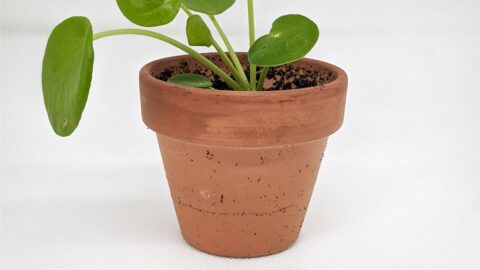
Pilea peperomioides carries round leaves on long stalks and often produces small offsets around its base. Those young plants are a practical way to share it. Bright indirect light, a draining pot, and watering based on the root zone support healthy growth without requiring a humid greenhouse or a permanently tiny container.

Recognize the leaf and growth habit
Also called Chinese money plant or pancake plant, this Pilea belongs to the nettle family but does not have stinging nettle’s irritating hairs. Each leaf stalk joins near the center of the round blade. A mature plant can develop a visible upright stem with leaves above and offsets below. The NC State species profile describes its origin in southern China and common indoor care.
Bright light and an occasional turn
Choose bright indirect light near a window. Gentle morning sun may be suitable after acclimation, but protect the plant from intense hot exposure. Rotate the pot occasionally if it leans toward the light. A long, weak stem may need a brighter position; removing individual leaf stalks does not make an elongated stem shrink or guarantee a bushier plant.
Use a pot matched to the roots
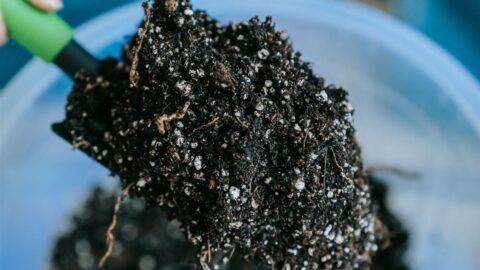
A light houseplant mix that holds some moisture and drains freely is suitable. The container needs holes, and the outer pot should not collect standing water. A small specimen may suit a four-inch pot, but that is not a lifetime limit. Repot when roots or deteriorating mix require it, moving up only modestly if more space is needed. See our repotting guide for preparation.
Water as the upper mix dries
Let the upper layer dry somewhat, check moisture deeper in the pot, and water thoroughly before the root ball stays dry for a prolonged period. Drain and empty the saucer. This plant does not need humidity instead of water at its roots. Avoid prescribing dryness to exactly two-thirds of every pot, since mix, root density, and depth differ. Our watering guide explains the relevant checks.
Room conditions and feeding
Ordinary household humidity is often adequate. Keep the plant away from cold drafts and hot air outlets, and measure humidity if the room seems unusually dry. Feed during active growth with a suitable houseplant fertilizer at its label rate. Reduce feeding when growth slows, rather than assuming every indoor plant becomes completely dormant in early fall. Fertilizer is not a first response to unexplained leaf drop.
Remove damaged leaves without stripping the plant
Remove fully dead or badly damaged leaves with clean tools, and wipe healthy foliage gently when dusty. Some older lower leaves may be lost as the plant matures. Removing many healthy leaves can weaken it, and pinching leaf stalks does not reliably produce new branches at those points. Assess the stem, light, and overall growth before deciding whether renewal by a stem cutting is appropriate.
Separate an established offset
Wait until an offset has a few leaves and enough growth to handle, preferably with its own roots. Loosen the root ball if necessary, identify its connection to the parent, and separate it carefully with a clean tool. Plant at the same depth in a small draining pot and keep moisture and light steady while it establishes. A very small unrooted shoot needs closer aftercare than a mature plant.
Stem cuttings need viable growth tissue
A healthy stem tip with viable nodes can be rooted to renew or multiply a plant. A leaf and its stalk alone are not a dependable route to a complete new Pilea; include the necessary main-stem tissue and bud if using a leaf-bud cutting. Root in a suitable moist, airy medium or water, and wait for roots to establish before potting on. Our stem propagation guide explains how nodes differ from leaf stalks.
Check roots and pests when leaves decline
Soft stems, rapid yellowing, or persistent drooping call for a moisture and root check. Both severe drying and excessive wetness can cause trouble, while cold and pests can contribute to leaf loss. Inspect undersides and stalk joints for mites, scale, and mealybugs. Isolate infestations and choose a labeled treatment for the identified pest; avoid scraping the plant with a knife. Recovery depends on healthy remaining tissue and corrected conditions, not repotting or fertilizer alone.
Hello, I own a pilea and everything seemed to go well until very recently when the leaves started drooping and some felt. They are curling a bit and I’ve noticed some brown spots here and there. What seems to be the problem? For reference, I’ve make sure to place the plant in a place where it receives indirect sunlight, I water it once every week and only use (diluted) fertilizer ever so sparingly.
When the leaves get curly ( as a taco) is because they are getting too much water. When I started growing pileas they did the same thing and I read somewhere that it was excess of water. I allow the soil to dry in between waterings and that was the solution. They don’t like to be wet and because the leaves are fleshy they store a lot of water.
Thanks for your insight! 🙂
I inherited five small cuttings that were potted together — they just started dropping leaves and leaf stems. Not sure if that’s due to over/underwatering or weather changes — I water about once a week and ketvthe soil dry out in between —all the cuttings seem to be developing new little leave but leaves on the larger cutting ( about 4 inches tall) and smaller ( about 2 inches high) are spreading out then falling off. Any ideas how to stop that … or is it just a normal transition after the trauma of “separation” . They near a window with blinds so diffused light. I think I’m doing something wrong — just not sure what!
Hi!
Sorry to hear you’re not having much luck with these cuttings so far. They can throw a temper tantrum for sure after being moved or separated, but that should pass after a few weeks. It’s very hard for me to establish what’s wrong without seeing the plants, but luckily I have an article that might be able to help you diagnose the issue yourself: Pilea peperomioides troubleshooting. I hope that helps you figure it out, good luck! 🙂
Hi! I have had my pilea for about two weeks I’ve watered thoroughly once already. The leaves aren’t droopy, well one is, but the rest are fine but I’ve noticed that the leaves are folding in like a taco. Any idea as to why? I have a huge east facing window so I dont think it’s a lighting issue.
Hi! It can be very hard to diagnose a plant without seeing it and knowing the exact conditions it’s growing in. Folding leaves can be caused by overwatering, too much light, draft, overfertilization…
I have an article that might help. I’ve compiled every problem with Pileas I can think of here – do you see anything that matches your issue and possible causes listed in here?
Anyway, I wouldn’t get too worried just yet. All plants go through an adjustment period once you bring them home, so it’ll likely turn out just fine 🙂
Hi, there I have 2 Pilea peperomioides however they are dropping there bottom leaves quite regularly and I wondered what I am doing wrong.
Hey! Have you had a look at the article on problems with Pilea peperomioides yet? It covers a whole bunch of different issues you can run into with your Pilea and why they might be happening, including some info on why a Pilea can start dropping leaves. It’s very difficult to tell you myself why it’s happening without knowing more details.
Hope that helps 🙂
Immediately upon the adoption of my pilea I took off on some travels. … a bit of overwatering and inconsistent care led to some yellowing leaves. I’ve recovered from the emotional shock lol but my question is regarding root rot. I looked just now and I think it’s okay the roots are very compact and not mushy, white in appearance. Just asking for some confirmation. There are lots of little babies in a circle around the main plant stalk. I think I’m okay but just asking since I’m a new pilea Mom
That sounds perfect. I don’t know if you saw, but I actually JUST posted an article on problems with Pilea peperomioides here. If you’re not seeing any of these symptoms any more then you should be good (although leaves that are already yellowed are obviously unfortunately not going to recover any more).
If there’s babies, growth, white roots and everything I would assume things are going just fine 🙂
Good luck with your Pilea!
Two questions:
Does pilea prefer to be repotted so there’s only one tall stalk or multiple?
How do you keep it looking full?
Hi! Repotting-wise, anything is fine as long as there’s enough room. As for fullness, it’s normal for plants to shed their lower leaves eventually. If you don’t like this look, your best option is propagation (beheading!). You simply cut off the full head and re-root that. I always leave the stalk because it tends to produce some good new growth as well, which I can then also use.
Hope that helps! 🙂
When you re-root the head, do you merely stick it in soil, or let it scab over first? Add rooting hormone? Thanks so much for your help! I have a mama Pilea that has given me 10+ awesome babies, and it seems a bit tired (no new mama leaf growth for a while).
I do wait one day or so just to be sure. Rooting hormone is always good, especially since beheading a Pilea is not the easiest way to propagate it.
Have you added fresh soil and/or some fertilizer to mama’s pot recently? I had a Pilea that didn’t do anything for ages until my mom decided to repot it, and now it’s sprouting babies and leaves left, right and center! 🙂
Any tips on how to steak my pilea to keep it upright? It’s grown so much it’s getting top heavy and leaning. Thank you!
Hi! I buy orchids sometimes and I like to keep the little stakes that they come with that support their flower spikes. I use those to stake other plants if necessary. But honestly, you could even use a chopstick and some thread or wire! Alternatively, I know some growers prefer to behead a top-heavy plant and propagate the top to turn it into two non-top heavy plants. 🙂
Good luck!