A Monstera is leaning away from its pot, so you gather the leaves against a pole and tie them into a neat bundle. It looks tidier. The problem is that the bundle may be holding the wrong parts.
The main stem is the climbing structure. A petiole is the stalk joining a leaf blade to that stem. Follow one leaf back to its attachment before deciding where the tie belongs.
Find the stem before fastening anything
Look for the thicker stem with nodes and aerial roots. Petioles branch from it toward individual leaves. Do not treat those outward-pointing leaf stalks as loose stems that need to be strapped upright.
Homes & Gardens’ support guidance recommends bringing the stems where aerial roots grow toward the support and fastening them without tight ties.
University of Minnesota Extension’s Monstera guide distinguishes stems, nodes, and petioles, and discusses support for climbing growth. Its propagation diagram can help identify the parts.
Use the tie to steady, not reshape
- Place a stable support beside the main stem without forcing a stake through the root ball.
- Bring the stem toward it only as far as it moves without strain.
- Use a soft, loose tie around the main stem and support, leaving leaf stalks free.
- Recheck the tie as the stem thickens and new growth develops.
If the plant will not reach the pole without bending hard, change the support position rather than tightening the tie.
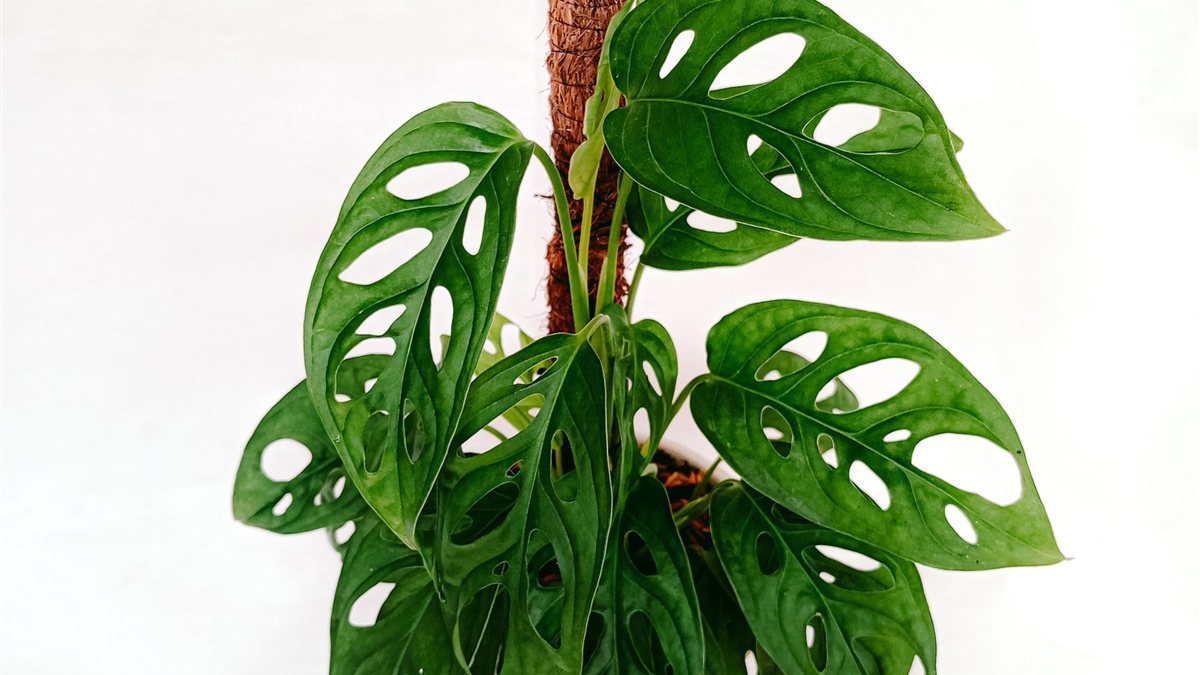
The photograph shows a supported Monstera adansonii. For the larger, split-leaved species, our Monstera deliciosa guide covers its broader needs.
A pole does not repair every lean
Check whether the whole pot is unstable, the light comes from one side, or the plant has outgrown its setup. Avoid moving into a much larger pot solely to hold a heavy pole.
Our repotting mistakes guide helps assess that decision. The support should steady the climber while leaving its leaves room to arrange themselves.